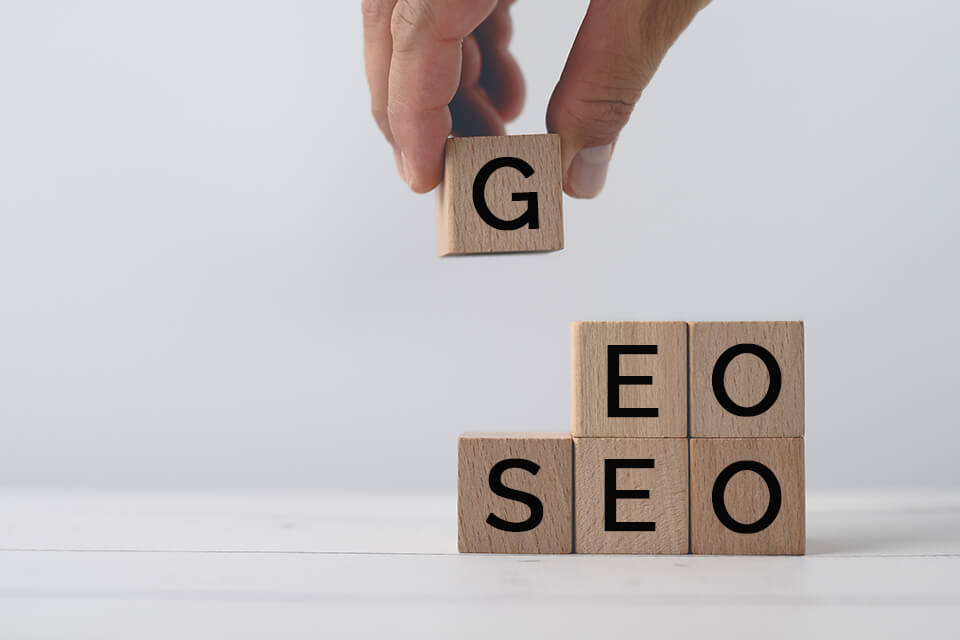

Marketing is all about getting your brand in front of potential customers. Two effective marketing tools to do just that are generative engine optimization (GEO) and search engine optimization (SEO). Both strategies increase your website’s visibility, but there are notable differences.
The most obvious difference stems from how people search for information. For years, search engines like Google and Bing have been the go-to for users looking for products, services, and general information. In 2025, Google alone processed approximately 9.5 million searches per minute. Traditional SEO marketing works to improve how your brand ranks in those searches. The higher your rank, the more visible you are.
In the past few years, though, there has been a subtle shift, and many users are now searching through AI systems like ChatGPT, Google Gemini, and Perplexity. According to Salesforce’s Connected Shoppers Report, 39 percent of consumers (and over half of Gen Z users) already use AI for product discovery. GEO marketing takes advantage of this trend and focuses on getting your information selected, summarized, or cited by AI systems.
What Are the Goals of SEO vs. GEO Marketing?
To look at it another way, with SEO marketing, you’re competing for position. Your content appears as ranked links that users can click. With GEO marketing, you’re competing for inclusion. Your content becomes part of AI-generated answers that users rely on as they make decisions.
What does the difference between SEO and GEO marketing mean for your business? And how do the two compare when it comes to strategy, optimization techniques, and user intent? Is one better than the other? Do you need both?
To answer these questions, let’s take a closer look at the differences between them and the benefits of each.
SEO Strategy and Techniques: Increase Discoverability
SEO marketing is built around how search engines crawl, evaluate, and rank pages. The goal is to rank high in search results and earn clicks from users across a wide range of queries. To achieve that goal, SEO’s strategies and techniques largely center around:
- Targeting keyword variations
- Keyword placement (titles, headers, metadata)
- Creating in-depth, relevant, rankable content
- Building authority and domain credibility through backlinks
- Technical SEO (crawlability, structured data, performance)
- Internal linking and site architecture
Your SEO lays the foundation of your marketing by ensuring the discoverability of your information.
GEO Strategy and Techniques: Emphasize Credibility, Accuracy, and Extractability
GEO marketing is built around how AI systems gather and synthesize information. The goal is to increase the likelihood that those systems recognize your content as trustworthy and use it in generated responses.
Since AI systems are generally looking for clear, concise information from a credible source, GEO strategies and techniques include:
- Factually precise, answer-first content that’s easy to quote, summarize, extract, and verify
- Structured formatting (clear headings, bullet points, FAQs, definitions)
- Verifiable facts and citations
- Demonstrating expertise and trustworthiness
- Building brand credibility across the web by getting mentions on other sites, in professional and industry publications, and on social media, and partnering with influencers
Your GEO marketing strategies increase your visibility to AI by positioning you as an expert and providing content that is easy to digest.
SEO vs. GEO Marketing and User Intent
One of the biggest differences between SEO and GEO marketing shows up in user intent. People in a research or exploratory phase are still figuring out what they need. They’re searching for information. Their queries tend to be short phrases and keywords like “best laptops” or “Thai food near me.” SEO marketing helps you reach these users by matching keywords and classifying intent.
When users know what they want and ask detailed questions, however, they expect a direct answer, not a list of links. Their searches are more conversational, immediate, and solution-focused. For instance, instead of “best laptops,” users might ask, “Which laptop costing less than $2,000 is the best for video editing?” That’s where AI systems like Google Gemini step in to extract and summarize information that answers the question. GEO marketing helps you become part of the answer for users who know what they want and are closer to a decision.
Strong SEO marketing increases visibility throughout the digital marketing funnel and often results in users visiting and clicking through to your website. GEO marketing might result in fewer clicks, but it increases your visibility and influence at the decision point.
How SEO and GEO Marketing Complement Each Other
Rather than competing, SEO and GEO marketing complement each other. In many cases, GEO depends on SEO. High-quality, well-ranked, and widely referenced SEO content often becomes the source material that AI systems draw from. GEO content improves how that content is interpreted and surfaced.
In other words, GEO content doesn’t replace SEO. Instead, it amplifies and extends it into AI-driven discovery. It’s the same content but optimized for the different ways that people consume information. It turns your pages from searchable resources into usable answers.
SEO marketing captures discovery and exploration, while GEO marketing captures clarity and decision-making in real time. Together, they cover how people discover information today, whether by searching or by asking.
Why Most Businesses Need Both
So, is one better than the other? No. Most businesses benefit from both SEO and GEO marketing. Using only one or the other limits your reach and creates blind spots. SEO and GEO marketing work best together because they influence different layers of discovery.
Your brand can show up when users search but also be included when users ask direct questions. Your content won’t just rank. It will become part of how information is delivered, trusted, and acted on for both search engines and AI systems. This combination maximizes visibility across the whole spectrum of the digital landscape.
Simply put, SEO ensures your content is found and ranked. GEO ensures your content is understood and used.
Are you using SEO and GEO together? Do you need some help with your SEO? Want to find out more about GEO? Make sure that your brand is visible no matter how users search for information, products, and services.